Blog
Close the Gap launches innovative new resource for businesses on domestic abuse
Close the Gap is delighted to launch a new resource for businesses on domestic abuse as part of Think Business, Think Equality, the online self-assessment tool designed specifically for SMEs.
The free online tool enables employers to self-assess their employment practice and provides tailored advice and an action plan which sets out the simple steps you can take so that your business can realise the benefits of gender equality and diversity. The new resource on domestic abuse also includes a range of free resources for download including:
- Guidance on domestic abuse and employment
- FAQ on domestic abuse and work
- Good practice examples
- Workplace resources
- Useful links including signposting to specialist support organisations
Think Business, Think Equality already includes six resources on key aspects of employment practice including flexible working, workplace culture, pay and reward, progression and promotion, pregnancy and maternity and job segregation.
The new test, which takes no longer than five minutes to complete, has been developed to enable businesses to effectively support employees experiencing domestic abuse. Domestic abuse not only affects the victim-survivor but can also impact colleagues, and ultimately the smooth running of a business through increased absenteeism, reduced productivity and higher turnover. Domestic abuse is estimated to cost the UK economy £66 billion a year, which includes the cost to businesses in lower productivity, administrative difficulties from unplanned time off, lost wages and sick pay.
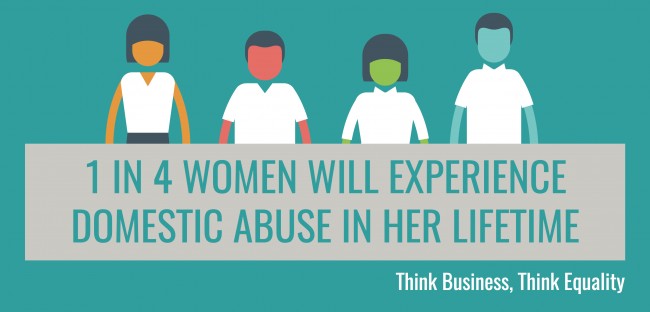
1 in 4 women experience domestic abuse in their lifetime in Scotland, so it makes good business sense to think about domestic abuse. As an employer, there are a range of simple, practical steps that you can take to ensure you effectively support your people, and protect your business.
The majority of women affected by domestic abuse are targeted at work. Perpetrators of domestic abuse often use workplace resources such as phones and email to threaten, harass or abuse their current or former partner. Perpetrator tactics such as sabotage, stalking and harassment at work, affect women’s ability to do their job, and to sustain employment.
Businesses that take steps to supports employees will benefit in a range of ways. Ensuring the safety and wellbeing of key people at work means that you're more likely to retain the skills and experience of female talent. By recognising the potential impact of domestic abuse on employees and their colleagues, you're minimising the risk to your business.
Delivering workplace equality makes good business sense. Having fair and flexible working practices allows you to attract and retain the best talent, reduce recruitment and training costs, and it makes your business more productive, more innovative, and more profitable. Evidence shows that gender equality at work is not just good for women, but is also a critical driver for improved business performance, and a worldwide catalyst for economic growth. Crucially closing the gender gap in employment is worth up to £17 billion to the Scottish economy.
Find out how your business can benefit from gender equality and diversity. Take the Think Business, Think Equality test on domestic abuse at www.thinkbusinessthinkequality.org.uk.
Want to know more about business benefits of gender equality? Watch one of our 30 second films.
If you’re on the move, you can download the Think Business, Think Equality app for iOS, Android or Windows.
July reading round up
This month we launched our new research which looks at the use of formal flexible working in Scotland, considering what type of employee works flexibly & how this has changed over time. The research shows that the extension of the right to request flexible working has not led to an increase in people working flexibly. ICYMI, you can catch all the highlights here.
In other women and work news:
Women working for NHS Scotland were paid less than men in all but two departments.
The rise of automation leaves women more vulnerable to job losses than men.
Our friends at Engender gave us a preview of the results of their menopause survey.
The Irish Government began drafting their new gender pay gap reporting laws.
The ONS released new figures on Britain’s ethnicity pay gap.
New Close the Gap research finds flexible working regulations aren't making work more flexible for women
In 2010, the UK Government extended the right to request flexible working regulations to all employees. Close the Gap’s new research, Flexible Working for All?, looks at the availability and uptake of flexible working in Scotland between 2010 and 2015 to identify whether this regulatory change has resulted in increased flexible working across Scotland’s labour market.
The research reveals that it has had very little impact on the uptake of flexible working, women’s access to flexible working specifically, and therefore gender equality at work more broadly.
The key findings include:
- The use of formal flexible working in Scotland has changed very little over the period of the study.
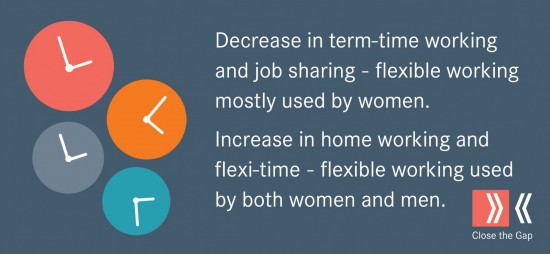
- There was some change in the use of individual forms of flexible working; small increases in the use of home working (4.0% to 4.9%) and flexi-time (12.0% to 12.3%) for which there is a broadly even gender split. However, there were small decreases in the use of job sharing (3.8% to 2.7%) and term-time working (1.7% to 1.1%) which are significantly more likely to be used by women than men.
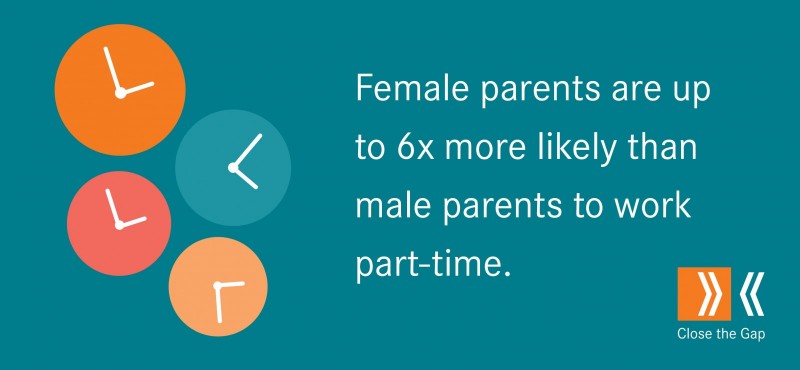
- Part-time work continues to be much more likely to be used by female parents than male parents, with little sign of change.
- Less than three-quarters (70%) of Scottish employees indicated that they had formal flexible working available at their workplace, even after the extension of the right to request.
- Over half of employees felt that they have access to informal flexibility however a fifth (20%) of employees indicated that neither informal nor formal flexibility was available at their workplace.
These findings reaffirm what we already know about the limitations of the right to request regulations. Employees have to be in their job for six months before making a request which creates a barrier to women looking to move to a new job. This is compounded by the very low proportion of jobs that are advertised as being available for flexible working; only 12% of jobs paying more than £20,000 are advertised as having flexible working options. This particularly affects women returning to work after taking time out to care and those who hold a series of fixed term contracts. Also, the eight business reasons employers can use to justify a refusal are very broad, so it’s relatively easy to refuse a request if there is a wider cultural resistance to flexible working.
This new research comes at an important time as the UK Government this week announced plans to consult on changes to the law which would improve transparency around employer policies on flexible working, and introduce a requirement for employers to consider advertising all jobs as flexible.
The business and economic cases on flexible working are clear; employers that enable their staff to work flexibly have access to a more diverse pool of talent, are able to retain key people, see their business become more productive. We therefore make a number of recommendations to employers in the report which aim to tackle a range of barriers to flexible working including:
- Advertising all jobs as flexible by default;
- Mapping types of flexible working of the organisation to identify gendered patterns;
- Ensuring that line managers have the skills and competence to identify creative solutions around the operational barriers to flexible working;
- Sharing profiles of employees on different working patterns; and
- Using Close the Gap’s online self-assessment tool, Think Business, Think Equality, designed specifically for smaller employers, and Close Your Pay Gap, a resource for large employers working to close their gender pay gap.
Reading roundup - May/June
 What a busy few months we’ve had! We supported the
#KidsCantWait campaign and called for early implementation of the family income
supplement, our Still Not Visible research was
supported by MSPs, and our Policy Manager, Lindsey Millen graced the pages of
Third Force News to school us all on the gender pay gap. Don’t worry if, like us, time has run away from you; we’ve
curated a selection of the essential reading on women and the labour market from
the last two months.
What a busy few months we’ve had! We supported the
#KidsCantWait campaign and called for early implementation of the family income
supplement, our Still Not Visible research was
supported by MSPs, and our Policy Manager, Lindsey Millen graced the pages of
Third Force News to school us all on the gender pay gap. Don’t worry if, like us, time has run away from you; we’ve
curated a selection of the essential reading on women and the labour market from
the last two months.
Women’s incomes were disproportionately affected by changes in pension credit entitlement.
Job design and workplace culture increase the propensity of women working part time.
The Investment Association issues warnings to 100 companies for failing to diversify their boards.
TUC research shows BME and LBT women are more likely to be sexually harassed at work.
Glasgow City Council were criticised for making deductions to equal pay claim awards.
A third of BME workers have been told to anglicise their names at work.
The undervaluing of “women’s roles” makes it hard to tackle occupational segregation in education.
Call for participants: Research on managing paid work with caring roles
Would you be interested in taking part in research which will expand the evidence base on the gender pay gap in Scotland?
Close the Gap is working with a PhD student at University of Manchester, Joanna Wilson, whose work is focused on Scotland's pay gap. Joanna is just about to start her field work and is recruiting interview participants to discuss how the level of workplace flexibility affects the unpaid caring they do. Joanna is looking to speak to both women and men, and is particularly interested in speaking to those in non-managerial jobs and self-employed. She would also like to speak to Black and minority ethnic people.
Participants will receive a shopping voucher as a thank you for their time.
Find out more about what's involved here.
 RSS
RSS