Blog
Close the Gap research finds that fixed term contracts are amplifying the inequalities and disadvantage that women face in the tech industry
At Close the Gap, we’ve started exploring how automation and the ‘fourth industrial revolution’ will drive changes in women’s experiences of work. To date, despite automation being something of a hot topic, little attention has been afforded to the impact on women’s employment specifically.
One of the expected impacts of automation is a growth in STEM roles. Women are currently under-represented in STEM and it is therefore likely that men will disproportionately benefit from future job creation, thus cementing women’s stark under-representation in the sector. There are also patterns of occupation segregation within tech sub-sectors with a dearth of women in AI and in its subsets of machine learning and deep learning, which has clear implications for the development of data-driven technologies.
As a key driver of the gender pay gap, occupational segregation is a core focus for Close the Gap but improving women’s representation within the tech sector is particularly important in the context of automation and potential changes in the broader labour market. As part of our wider work on automation, it is therefore necessary to explore the barriers to women’s participation and progression into tech roles.
Data from ONS highlights that in Scotland women account for just 16.9% of IT and telecommunications professionals which includes roles in programming, software development, web design and development, business analysis, and systems design. A similar proportion of women (18.0%) comprise IT technicians in Scotland.[1] UK-wide research by the PwC in 2017 found that only 5% of those in tech leadership roles are women.
Equate Scotland, Scotland’s national organisation working on women in STEM, does a range of work with women and employers in the tech sector to challenge the barriers that exist. There has also been a myriad of short-term, supply-side initiatives, predominantly in education settings, to address the under-representation of women in the sector, including coding clubs for girls, school-based activity to encourage more girls to take STEM-related subjects and outreach work such as tech workplace visits. However, we haven’t yet seen a strategic policy response to the persistent dearth of women in tech.
Research by Close the Gap with women working in the tech industry in Scotland [2] highlights that insecure working practices are likely to pose an additional barrier to women entering and progressing in the industry. This new data gleans useful insight into some of the changes that are required to job design if employers are to challenge the current patterns of occupational segregation.
Women’s employment in general is increasingly precarious, with women more likely to be in low-paid work, and on temporary and zero hour contracts. This new research highlights that this rising insecurity may be an issue for some women in the tech sector. The key findings include:
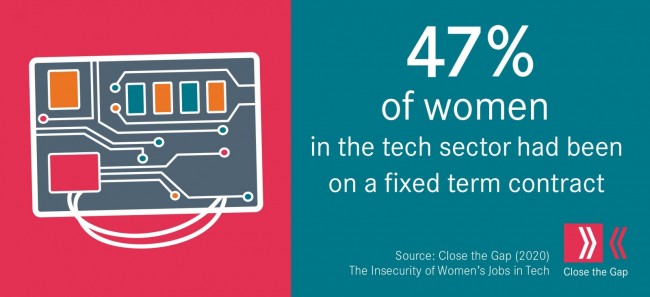
- Almost half (47%) of respondents had been on a fixed term contract in the tech sector and 45% viewed fixed term contracts as a common feature of their experience in the sector.
- 46% of respondents felt that fixed term contracts amplified the inequalities and disadvantage that women face in the tech industry.
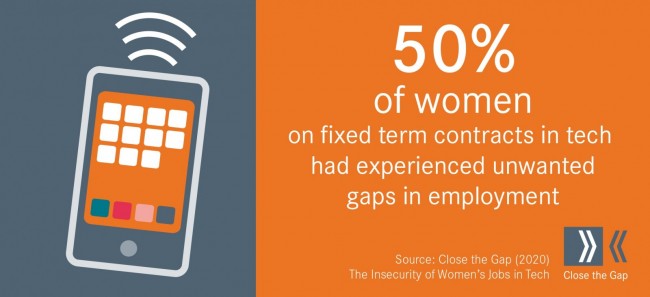
- Half (50%) of respondents who had been on a fixed-term contract had experienced involuntary gaps in employment.
- Fixed term contracts were seen as having an adverse effect on the ability of respondents to plan for the future (70%), on their financial situation (53%) and their mental health (40%).
The majority of respondents viewed fixed term contracts as being both a positive and a negative (61%). However, only 9% saw fixed term contracts as being a positive feature of the tech industry, while more than a quarter (27%) believed such contracts to be a negative feature.
Some of the positive comments around fixed term contracts were that they can provide flexibility and can support a return to work after maternity leave or a career break. However, that fixed term contracts are seen as providing relative flexibility may also be reflective of the lack of other flexible and part-time working opportunities in the tech sector. Currently, just 6% of information technology roles are advertised on a flexible basis making it difficult for women in tech to balance earning with caring. A lack of quality part-time and flexible work in the labour market is a key contributing factor to women’s skills-related underemployment, occupational segregation and the gender pay gap. Given the technological infrastructure available in the sector, and the emphasis placed on agile working, the sector should be leading the way in flexible working practices.
Certainly, the tech sector remains characterised by horizontal and vertical occupational segregation. There are further differences in the types of work women and men do, with women more likely to be in project management, web design or technician jobs, while men are more likely to be programmers and engineers.
While 44% of respondents in programming and 51% of those in software development have been on a fixed term contract, this figure rises to 100% for those working in online education and to 70% for those in digital media. While sub-sectors use fixed term contracts to varying degrees, it appears that fixed term contracts are used to a lesser extent in those sub-sectors which are particularly male-dominated. Those roles where women are under-represented are the jobs which attract higher pay and more secure contracts.
Occupational segregation is reinforced by the prevailing workplace culture in the tech sector. Un-transparent and biased recruitment practice, and a lack of access to informal networks continue to prevent women from entering and progressing in the industry. Research published by ScotlandIS, the trade body for the digital technologies industry, also identified evidence of sexist workplace cultures in which women report feeling undervalued, being excluded from discussions and discouraged from pursuing more technical projects, being talked over at meetings, and being asked to do lower status admin tasks that are not related to their role.
Fixed term contracts were seen as having an adverse effect on key aspects of employment such as pay, progression and pensions, potentially exacerbating women’s existing inequality. Of those who were currently, or had previously been, on a fixed term contract half (50%) had experienced involuntary gaps between successive fixed term contracts which can have longer term impacts on women’s career progression, lifetime earnings and likelihood of experiencing poverty.
While a majority (60%) of respondents agreed that that they had taken a job or worked on a project below their skill level because of being unable to find appropriate work, this rose to more than three-quarters (78%) of respondents who had been on a fixed term contract. These insecure working practices are likely to be contributing to women’s higher rates of underemployment and the under-utilisation of women’s skills, which contributes to skill shortages and is a drag on economic growth.
In terms of the effects on broader life factors, fixed term contracts were seen as impacting the ability to plan for the future (70%), the respondent’s financial situation (53%) and their mental health (40%). A lack of affordable, flexible and accessible childcare is one key reason for women’s systemic inequality in the labour market, and respondents noted the additional difficulties of accessing childcare while on a fixed-term contract.
The research found that almost half (46%) of respondents felt that fixed term contracts amplified the inequalities and disadvantage that women face in the tech industry. However, among participants who had experience of fixed term contracts, this figure rises to 58%. In addition to the plethora of barriers facing women upon entering and progressing within tech, such as gender stereotyping and male-oriented workplace cultures, these results highlight that fixed term contracts may be an additional barrier.
STEM is both a key focus of Scotland’s Economic Strategy, and the Scottish Government Labour Market Strategy. However, these findings highlight that it is necessary to take a broader approach to efforts to address women’s under-representation, including tackling toxic workplace cultures and the quality and security of the jobs in tech that are more likely to be done by women. Addressing demand-side barriers to women entering and progressing within STEM is particularly pertinent given existing evidence on the potential impact of automation. Women workers are concentrated at the extreme ends of the automation spectrum, with women over-represented in jobs that are at the highest risk of automation, and under-represented in STEM where job growth is likely to result.
It is vitally important, therefore, that Scotland’s response to automation and the changing labour market is gendered, thus ensuring new technologies do not cement, or indeed, worsen existing gender inequalities. AI may accelerate digital disruption in the jobs market and pre-existing research and analysis has shown that this disruption is expected to have a gendered impact. As part of our new Women’s Future Skills project, this year Close the Gap will be bringing a focus to women’s skills and automation, looking at not only women in STEM, but also how technological change affects women’s employment in the wider labour market. Crucially, we’ll be looking at how gender competent policymaking can ensure that technological change doesn’t entrench women’s labour market inequality in Scotland.
Overall, this new data offers further evidence of the importance of fair and flexible work to women’s labour market equality. reviewing the design of jobs in tech, and developing gender-sensitive employment practice for example through offering flexible working at all levels, can enable more women to enter and progress within the sector, with benefits not just for individual women and their employers, but also for Scotland’s economy.
[1]
Annual Population Survey (June 18-June 19) Regional employment by occupation
[2] The primary research, in the form of an online survey, was undertaken by Close the Gap over the course of 2018. The online survey comprised 11 close-ended questions, 7 demographic questions and 1 open-ended question. There were 92 participants who were sourced through social media, networks of women working in the tech industry in Scotland and key stakeholders working with women in tech.
New legislation puts gender equality at the heart of the Scottish National Investment Bank
Facilitating changes in policy can be a slow process, and it’s often very difficult to measure your impact and success. So, when your advocacy has a clear and tangible impact, we don’t think it should pass without note!
Over the past few months, Close the Gap has been working closely with Engender to promote the importance of building gender equality into the design of the Scottish National Investment Bank (SNIB).
Traditionally, economic development agencies have not incorporated women’s specific needs and have not prioritised women’s equality. Consequently, the gender pay gap remains at 13%, and if numbers of women-led businesses in Scotland increased to equal those of men, it would lead to a 5% increase in GDP, equivalent to £7.6bn. We thought the SNIB was a chance to do things differently.
Earlier this week, the legislation to create the Bank was passed by the Scottish Parliament. Importantly, and very excitingly, Close the Gap and Engender’s six key asks are contained within that piece of legislation. We achieved:
- An additional ancillary object relating to equality and non-discrimination;
- The Bank’s vision statement, which had been articulated in the Implementation Plan, is now on the face of the Bill thus giving permanency to the more ambitious and transformational aspects of the Bank;
- The mission setting process has been refined, meaning that Ministers will have to consider how missions will further equality;
- The Bank is required to publish and review a gender equality strategy;
- The Bank must gather intersectional gender disaggregated data on its investments, programmes and services, and report on its progress against the Gender Equality Strategy; and
- The Bank is required to carry out a regular equal pay review.
That the Bill was changed to include all of these amendments is a big success and will have positive impact on women’s experiences of working within the Bank, the Bank’s gender pay gap, and women’s wider social and economic equality in Scotland.
That the Bank will be required to carry out a regular equal pay review is a really positive development for the financial services as a whole, a sector that has been characterised by unequal pay and large gender pay gaps. Close the Gap research into employer reactions to the pay gap uncovered employer complacency, with less than a third undertaking an equal pay review or having any plans to do one in the future. The Bank will not be able to be complacent about potential discrimination in its pay systems.
How did we get to this point?
Our work on the Bank started in November 2017, when Close the Gap joined together with Engender, the Scottish Women’s Budget Group and Women’s Enterprise Scotland to produce seven principles for a gender-competent Scottish National Investment Bank.
This has been a multi-pronged approach to advocacy that’s seen us write numerous briefings, respond to three formal Government consultations, meet opposition MSPs, Cabinet Secretaries, and work with the Bill team. We had the support of Jackie Baillie MSP, who lodged our amendments and spoke eloquently about the need for gender equality to be at the heart of the Bill in committee sessions and in the chamber.
Before the Bill was even introduced, in line with the recommendation contained within Scotland’s gender pay gap action plan, A Fairer Scotland for Women, we were working with Government officials on the equality impact assessment. At stage one, we provided briefings to MSPs which outlined our ambitions for the Bill. We also tried to build alliances across the third sector, working with SCVO and Social Enterprise Scotland to give a stronger voice to our gender equality messages.
At stage two, Jackie Baillie brought amendments to Bill at the Economy, Energy and Fair Work Committee. We made some good progress against our objectives at this stage with changes to the mission setting process agreed, the vision being added to the Bill along with an equality and non-discrimination objective, albeit with compromise wording.
Crucially, we also achieved verbal commitments for the Cabinet Secretary to work with us ahead of stage three to discuss the opportunities for further amendments. This meant more briefings and meetings ahead of stage 3, working with various stakeholders to draft robust amendments pertaining to the gender equality strategy and equal pay reviews. This was difficult because there was not a precedent for some of our ambitions in pre-existing UK legislation. For example, lawyers had to establish wording for intersectional data.
On Tuesday, our remaining amendments were agreed in the chamber at stage three. Encouragingly, we were pleased to see that all parties supported integrating women’s equality into SNIB, with three of the amendments passing without a vote.
Accountability on gender equality has been built into the Bank. Along with Parliamentarians, Close the Gap and Engender will continue to scrutinise the work of the Bank, ensuring that they bring forward an ambitious and robust gender equality strategy. The intersectional gender-disaggregated data which will be gathered by the Bank will also provide valuable insight into the experiences of different groups of women in accessing finance and working within financial institutions.
This piece of legislation also opens other doors for us in that it sets an important precedent. In future legislative processes, we can ask ‘if a gender equality strategy works in the context of the SNIB Act, why not here?’. If the Bank can carry out regular equal pay reviews, why can’t the other economic development agencies? With these asks in mind, keep an eye out for our forthcoming Gender Pay Gap manifesto ahead of the 2021 Scottish Parliament election.
Policy change can be slow and long-term, so we were delighted to see the Bill pass this week. Now we are looking forward to working with the Bank to realise the possibilities that have been established with the passing of this legislation.
The detrimental impact domestic abuse has on women’s employment
The 25th of November marks the first day of the 16 Days of Activism for the elimination of violence against women and girls, an international campaign dedicated to raising awareness that violence against women is an enduring social problem.
This year as part of the 16 days of activism, we wanted to share an experience from a victim-survivor of domestic abuse, Kate, to highlight the impact it had on her life and experience at work. As a result of domestic abuse, and despite her employer having a domestic abuse policy in place, Kate was forced to move from a senior, full-time, permanent job to a lower-paid, part-time, temporary role with a different employer. She had to trade her professional status, income, job security, current and future earnings and pension in order to feel safe at work.
Equal Pay Day sharpens the focus on pay discrimination
Recent data from the Office for National Statistics revealed that Scotland’s gender pay gap had narrowed ever so slightly from 14% to 13%. We aren’t celebrating though because it still represents a lifetime of inequality for working women.
Equal Pay Day is the day from which women are effectively working for free for the rest of the year because of the gender pay gap. Of course it's much earlier in the year for Black and minority ethnic women and disabled women, who experience higher gender pay gaps. Having this day each year brings into focus the stubborn challenge of one of the pay gap's main causes – pay discrimination. Media coverage of recent high profile equal pay claims such as that brought against the BBC by Samira Ahmed, and the hard-fought settlement won by women workers at Glasgow City Council highlights the scale of the challenge. Pay discrimination affects individual women and it’s also a feature of female-dominated jobs and sectors because the economy systemically undervalues the work they do.

Gender pay gap reporting was meant compel employers to take action to address any pay gaps, including looking at the challenge of pay inequality. But as yet there’s little evidence that action is being prioritised. Quite the opposite, in fact. Close the Gap’s assessments of gender pay gap reporting among Scottish employers has found pay becoming increasingly invisible. In 2018, out of 200 employers who’d reported their pay gap, only one mentioned doing an equal pay review and another mentioned plans to look at job evaluation. What was commonly found was a generic statement on employer reports which said: “The gender pay gap is not the same as equal pay which is unlawful. We are confident that we’re providing equal pay for all staff”. It’s difficult to see how so many employers can be so confident since the vast majority have never done an equal pay review, nor have any plans to do one. The gender pay gap is not just about pay but pay is still important, and that message is getting lost.
If you think you're being paid unfairly because you're a woman, there's information on our website about what you can do next.
If you're an employer who wants to check whether you're paying staff fairly, Close the Gap has developed online tools to help you. SMEs can use our Think Business, Think Equality self-assessment tool which has a resource on pay and reward. Large employers can use our Close Your Pay Gap tool which also includes a self-assessment test and lots of free resources.
The Living Wage can loosen the grip of women’s poverty
Living Wage Week is an opportunity to recognise the importance of the living wage in lifting women out of poverty and enabling fair work for women.
Women continue to account for the majority of low-paid workers in Scotland and research from Living Wage Scotland has shown that women in part-time work stand to benefit the most from Living Wage accreditation.
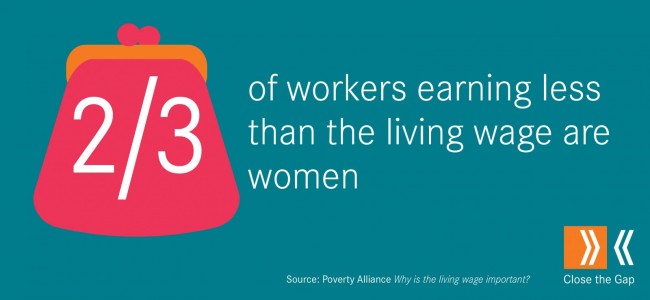
Women’s employment is becoming increasingly precarious with women accounting for two-thirds of workers earning less than the living wage and 55% of workers on zero-hour contracts. The rise in women’s self-employment has also coincided with a rise in low-paid self-employment.
Women’s experience of the labour market is ultimately linked to women’s experience of poverty. In Scotland, women are more likely to be in poverty than men; are more likely to experience in-work poverty; find it harder to escape poverty and are more likely to experience persistent poverty than men. In line with the multiple labour market barriers experienced by different groups of women, the risk of poverty is even greater for black and minority ethnic, disabled and refugee and asylum-seeking women.
The Scottish Government have recognised the inextricable links between gender and poverty, and women’s poverty and child poverty in a number of key policy documents including Scotland's gender pay gap action plan, and the child poverty delivery plan. These plans are clear that tackling the gender pay gap is essential to overcoming women’s higher rates of in-work poverty, and child poverty in Scotland.
It’s vital that the Scottish Government and other policymakers adopt a gendered approach to all labour market policymaking and analysis of low pay in Scotland. At present, this is often not the case with key labour market policies failing to consider women’s different experiences of work, and policy analysis which does not recognise women’s distinct experiences of low-pay and poverty. We also continue to see analysis pertaining to low-paid workers, lone parents and child poverty without any consideration of the gendered causes.
It is also distinctly unsurprising that women make up the majority of workers being paid below the living wage, because women’s preponderance in low-paid work is a major cause of the gender pay gap. The gender pay gap represents a lifetime of inequality for women. Responses to the pay gap often focus on getting more women into senior roles. While vitally important, this ignores the fact that the gender pay gap is also caused by women’s concentration in low-paid, insecure and undervalued work such as care, retail and cleaning.
Work that is seen as “women’s work” is systematically undervalued in the labour market because this work is done by women. Practically, undervaluation means that women will receive lower rewards from investing in education or from their own work experience, and undervaluation thus underpins both occupational segregation and the pay divergence that accompanies it. While the payment of the living wage in these jobs and sectors is an important start, ultimately this has to be accompanied by a more structural response to the continued economic undervaluation of work done by women.
Women are more likely than men to have caring responsibilities and therefore must find work that allows them to balance earning with caring. This sees women concentrated in part-time work. However, most part-time work is found in the lowest paid jobs and part-time jobs are more than three times as likely to pay below the living wage than full-time roles.
Lone parents, 91% of whom are women, may be juggling several low-paid jobs at the same time to earn enough to make ends meet. Almost half (48%) of single-parent households are living in poverty, compared to a quarter (24%) of couple households.
The payment of the Living Wage in female-dominated sectors such as care, catering and retail is an important mechanism to lift women and their families out of poverty. Every Child, Every Chance has a focus on engaging with particular sectors such as tourism and hospitality where women’s low pay is a concern. The Plan outlines how these sectors, as key growth sectors of the Scottish economy, needs to play its full role in ending child poverty.
We also need a step change in employer responses to part-time and flexible working. Too often, there’s a cultural presumption against part-time working in senior grades, and in male-dominated jobs and sectors. This prevents women from progressing, and sustains their concentration in the lowest paid jobs in the labour market. Presently, only 12% of jobs paying £20,000 or more a year are advertised on a flexible basis, and research by Close the Gap has shown that the right to request regulations, extended to all employees in 2014, have not resulted in the normalisation of flexible working, as was envisaged.
Employers that pay their staff the real Living Wage, and enable them to work flexibly at all levels, will be able to benefit from the well-evidenced gains of gender equality at work. This will also enable us to challenge women’s poverty, meet Scotland’s targets on child poverty and make real progress towards closing the gender pay gap in Scotland.
While women continue to represent the majority of workers being paid below the living wage, we will be unable to realise the ambition of enabling access to fair work for women in Scotland.
 RSS
RSS