Blog
Events: Scotland & UK
In this post you will find a selection of up and coming events and programmes relating to gender equality and women's participation in the labour market.
___________________________________________________________________________________
Close the Gap
She works hard for the money - how gender budgeting can promote women's equality in Scotland
Tuesday 7th June 10am - 4pm
Venue: The Glasgow Women's Library, Glasgow
FREE
In partnership with Engender and the Scottish Women's Budget Group, Close the Gap Over will be co-hosting an event about gender budgeting. This event will give participants the chance to find out more about the work of the Scottish Women’s Budget Group, and the opportunity find out how they can get more involved.
Speakers include, Dr Angela O’Hagan, convenor of the Scottish Women’s Budget Group, and Emma Ritch, Executive Director of Engender.
___________________________________________________________________________________
Engender
Women and the EU: discussion workshop
Venue: North West Women's Centre - Glasgow
FREE
Join Engender, learn more about how staying in or leaving the EU might affect women in Scotland. This workshop will provide an opportunity for discussion on how women can get involved in the debate over the EU referendum, and what the key issues are for women.
No need to book. Lunch provided.
Women and the EU: Debate
Tuesday 21st June 12.30 - 14.30
Venue: North West Women's Centre - Glasgow
Join the North West Women’s Centre and representatives from the ‘Scotland Stronger In’ and ‘Vote Leave’ campaigns for a debate about whether we should stay in the EU, and what that might mean for women.
No need to book. Lunch provided.
__________________________________________________________________
EQUATE SCOTLAND
Taking positive action to build your talent pipeline
15 June 09.45- 13.00
Venue: Glasgow: Stirling Court Hotel, Stirling University, FK9 4LA
FREE
This half-day seminar aimed at employers in the engineering sector. The day focuses on how you can take positive action to address the gender imbalance in engineering and attract more women into the sector. Participants will hear from employers who have taken action - by offering work-based placements and returnships, the women they’ve supported, and a legal expert will provide guidance.
Find out more about this event or Book for this event
Celebrate National Women in Engineering Day
23 June 19.00 - 21.00
Venue: Glasgow: IET Glasgow: Teacher Building, 14 St Enoch Square, Glasgow, G1 4DB
FREE
To mark this year’s National Women in Engineering Day, Equate Scotland is once again joining forces with WES Scotland and hosting an evening networking event in Glasgow. ‘Be Inspiring, Be Inspired’ will give you the chance to hear from a panel of invited speakers, with opportunities for networking.
Find out more about this event or book this event
________________________________________________________________
Center for Gender History
Who Cares? Gender, care-provision and inequality.
3 June 09.00 - 17.00
Venue: Glasgow Women's Library - Glasgow
FREE
One-day public engagement workshop,exploring the links between gender, care-provision and inequality, past and present. It will bring together academics, representatives from the public sector and the voluntary sector, and women's rights campaigners, in order to combine historical and current perspectives on the range of possible arrangements for fulfilling one of society’s basic human needs: care.
________________________________________________________________
Napier University
Tackling inequality in the labour market: what works
10 June 10.00 - 13.00
Venue: The Rivers Suite, Edinburgh Napier University, Craiglockhart campus - Edinburgh
FREE
This workshop will hear from a range of speakers about the important role employers can take in tackling these inequalities in the labour market and some of the approaches currently being adopted by a variety of employers in Scotland. It will give insights as to which approaches work best and why in terms of achieving sustained change. These discussions will be underpinned by research on a range of key sectors in the economy, which has been undertaken by researchers at Edinburgh Napier University.
Speakers will include: KPMG; Business in the Community Scotland; Flexiworkforce; City of Edinburgh Council; Oxfam; and the Fair Work Directorate at Scottish Government.
________________________________________________________________
Glasgow Rape Crisis Centre
40th Anniversary fundraising night
1st July 19.30 - Late
Venue: Blackfriars Bar - Glasgow
Cost - £5
Glasgow Rape Crisis Centre will be celebrating its 40th anniversary. There will be a DJ, raffle prizes and special prize draw on the night.
Mammoth fundraising book sale
30 July 11.00 - 16.00
Venue: The Spoon Cafe, Albion street- Glasgow
FREE
Glasgow Rape Crisis Centre will be hosting a fundraising book sale to help mark their 40th anniversary. The sale will be opened by GRCC patron and award winning author Denise Mina. All kinds of books will be on sale from children’s books to gardening to thrillers to politics. Come along to browse and buy – and the café will be open so you can stay for tea and cake. Please share to show your support and to help GRCC raise funds! All welcome.
________________________________________________________________
Scottish Refugee Council
International women groups presents 'Open hearts, open doors'
4 June 11.00- 16.00
Venue: Bishopbriggs Free Church of Scotland, 13 Auchinairn Rd - Glasgow
FREE
Part of the Refugee Festival Scotland, this event includes stories and photos of the high rise flats, and the welcoming of the Jewish refugees after the Second World War. Celebrating the contribution of women to history, all women welcome.
________________________________________________________________
WISE - Women in Science and Engineering
A wide range of events across the UK from small workshops through training courses to major conferences. See more information
May's news roundup
There's a lot to talk about in this month's news roundup. We've had gendered expectations around clothing, from the playground to the workplace; concerns around the lack of progress towards gender diversity in the boardroom, the police force, and government; and the latest ONS data has revealed the value of unpaid work in the UK economy (overwhelmingly done by women) to be a staggering £1trillion! We've pulled together all of this month's stories relating to women and employment just in time for your Tuesday teabreak.
Consulate fined £2000 for discriminating against mother during job interview
UK could add £10.1bn to economy by tackling the challenges women face to starting a business
Police Scotland chief 'worried' as two new senior posts attract no female candidates
New research from Highlands and Islands Enterprise on attitudes & aspirations of young people in H&I
Scottish Enterprise hold roundtable event on improving boardroom diversity
Women and Equalities Committee launches sexual harassment and sexual violence in schools inquiry
EHRC launches its new campaign to help young pregnant women know their rights at work
Everything you wanted to know about gender budgeting but were afraid to ask
Work dress codes, high heels, and patent sexism
Female temp worker sent home from PwC office without pay for not wearing high heels to work
Close the Gap’s blogpost on our latest gender pay gap statistics paper
Citizens Advice records 25% rise in pregnancy & maternity discrimination
Trio of lawyers who broke glass ceiling hit out at culture of inequality still persisting
And topping the 'ugh' charts this month
Everything you ever wanted to know about gender budgeting but were afraid to ask

Have you ever wondered who benefits from public spending decisions? Women use public services to a greater degree than men, but does that mean they benefit in equal or greater measure from the public purse?
Historically, government spending decisions are viewed as gender-neutral, and it is often assumed that women and men benefit equally. We know, however, that structural inequalities are still embedded in society and women do not enjoy equal access to resources. As a result, budget decisions more often than not have an unintended, differential impact on women and men.
Gender budgeting aims to raise awareness of the different impacts on women and men of publicly funded policies and programmes. It seeks to integrate gender analysis into economic policy and government spending plans.
This means examining how the allocation of public funds affects the economic and social opportunities of women and men; a process which provides strong evidence to support a more gender equal budgetary process, and equality of outcomes for women and men.
New Working Paper on Scotland's gender pay gap
Close the Gap has recently published its most recent working paper on gender pay gap statistics with a specific analysis of Scotland’s gender pay gap.
The paper uses the Annual Survey of Hours and Earnings (ASHE) tables to calculate the average difference in pay between women and men working in Scotland.
The overall mean gender pay gap has remained high at 14.8% for Scotland, meaning that women on average earn 85p for every £1 men earn.
The part-time pay gap has increased by over 1 percentage point to 33.5%. The part-time pay gap is calculated by comparing part-time women’s average earnings to men’s average full-time earnings, and is illustrative of the concentration of part-time work in undervalued low paid work such as cleaning, admin, caring and retail.
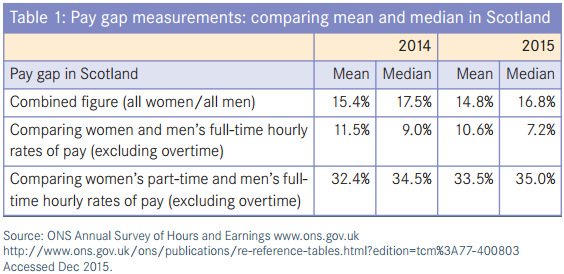
The working paper also provides information on the average difference in earnings in across different age groups, occupational groups, and an analysis of the Scottish gender pay gap over time.
April's news roundup
It has been a busy month in the land of women and work, with stories focussing on the early presence and impact of gender stereotyping in children and young people's lives, discrimination in employment contracts and hiring processes, women's organisation's voices in the upcoming Scottish Election, and the economic benefits of gender equality. We've pulled them together here, in one handy post, for all your gender and employment news needs.
Is it time for a women’s trade union?
The gender pay gap never quits: it won’t even stop working when you do
'Boys will be boys': Are gender stereotypes harming Scottish children?
EHRC find new junior doctor contract discriminates against female medics and is potentially illegal
Just one in five films made in Europe is directed by a woman
Workplace health and safety risks force pregnant women and mothers to quit jobs
Sixteen women’s organisations sign up to Engender’s call for single payments of Universal Credit
Women’s organisations warn switch to Universal Credit will trap women in abusive relationships
Paypal hold all-male panel on gender equality in the workplace
Economy could be £17bn better off by eliminating the gender gap, Close the Gap report finds
Engender launch new paper on Scottish parliament election asks on violence against women
Nicola Sturgeon pledges to impose penalties on councils dragging their feet on equal pay claims
Discrimination, “choice”, and the gender pay gap
Middle class feminism has a blind spot over female cleaners
Only one fifth of working women in Scotland are employed in STEM
Women’s Budget Group publish comprehensive gender assessment of the UK 2016 Budget
Research shows only a tiny proportion of new fathers are opting for shared parental leave
The role of early years professionals in tackling gender stereotypes
Female architects speak out on industry sexism in tributes to Zaha Hadid
Extent of gender stereotyping laid bare in short film depicting primary school children’s drawings
And finally, taking the biscuit this month we have:
 RSS
RSS