Blog
New Close the Gap research finds women’s labour market equality worth £17bn to the Scottish economy
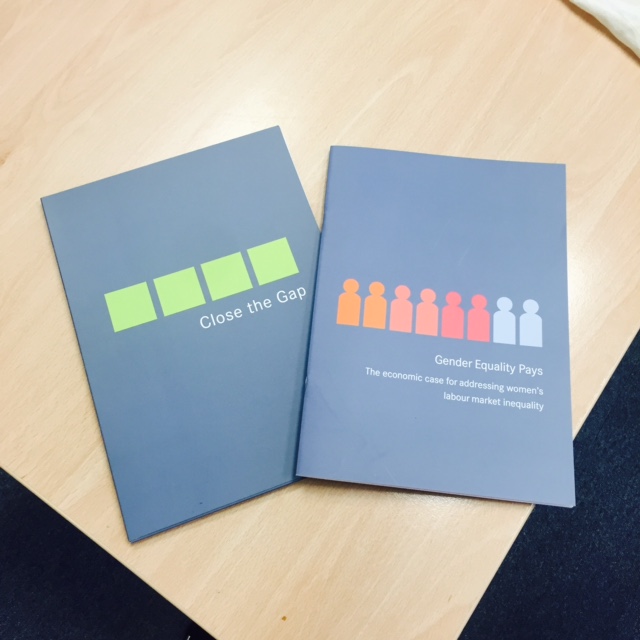
Last week we launched our new research report, Gender Equality Pays. The research, which reviews evidence of the economic case for addressing women’s labour market equality, was carried out by Emily Thomson at Women in Scotland’s Economy research centre at Glasgow Caledonian University.
It revisits and updates previous research by Close the Gap in 2007 which examined the link between actions to advance gender equality and profit at the organisational level.
Gender Equality Pays identifies clear and mounting evidence that gender equality at work is not just good for women, but is also a critical driver for improved business performance, and a worldwide catalyst for economic growth. The report highlights a flourishing of evidence in three key areas:
- The correlation between gender balance at senior level, and improved corporate and financial performance.
- The business benefits of providing flexible or agile working;
- The macroeconomic gains where women's under-used skills are more effectively utilised across the labour market, particularly in sectors which are characterised by occupational segregation.
Crucially, closing the gender gap in employment could be worth more than £17bn to the Scottish economy.
The report also includes case studies of companies that are already benefiting from taking actions to advance women’s equality.
The findings come at a critical time. The restructuring of Scotland’s labour market since the Great Recession has entrenched the gendered inequalities in labour market participation, particularly in relation to underemployment. Women’s employment in general has become more precarious through an increase in redundancies, temporary work and zero hour contracts.
To close the gender gap in employment, we need programmes of work from policymakers at all levels which target the gendered barriers to the labour market. We also need to employers make meaningful changes to workplace policies and practices. Because the clear message from the growing evidence base is that gender equality pays. For women, business, and the economy.
Read the report here.
EVENT: Gender Equality Pays research launch
Close the Gap is launching a new report, Gender Equality Pays, which reviews the evidence of the business and economic cases for addressing women’s inequality in the labour market.
The research, which was undertaken by Women in Scotland’s Economy (WiSE) research centre, demonstrates that there is a sound business case for individual employers to take steps to address gender inequality through flexible or agile working, and increasing women's representation at senior levels. The research also finds that there is clear and mounting evidence indicating that gender equality could hold the key to unlocking Scotland’s productive potential in a post-recession economy.
The event will be held at:
10.15am - 11.45am on Friday 22 April 2016
Room A527A
Govan Mbeki Building
Cowcaddens Road
Glasgow G4 0BA
Tea and scones will be available.
Register here
Close the Gap assessment reveals significant regression in public authorities' compliance with the public sector equality duty
Close the Gap completed its second assessment of public authorities’ compliance with the gender and employment requirements of the public sector equality duty. By 30 April 2015 listed public authorities were required to publish:
- an updated mainstreaming report;
- updated gender-disaggregated employee data;
- a report on progress to meet equality outcomes; and
- an updated gender pay gap figure.
We looked at the same sample of public authorities that were included in our assessment of 2013 reporting, which included organisations from local government, higher and further education sector, the NHS, and non-departmental public bodies.
Among the sample of public bodies assessed, compliance with the duty has largely regressed, with the majority of public authorities assessed as having lower scores than in 2013. Just under a third achieved an improved score.
Key themes from the report include:
- incomplete, inconsistent, and insufficiently detailed gender-disaggregated data;
- significant under-reporting on pregnancy and maternity;
- more than half of the public authorities assessed had no outcomes on gender on employment;
- a significant lack of evidence on progress to meet equality outcomes; and
- inadequate gender pay gap reporting including miscalculations, poor or no analysis of the causes, and failure to set actions to address the pay gap.
The full report is available here.
The regression of public authorities’ performance is particularly concerning as our assessment work of 2013 reporting, and research by the Equality and Human Rights Commission, revealed that performance in 2013 was already poor.
It’s clear that there are significant challenges for public authorities in complying with the public sector equality duty. These include a lack of knowledge and understanding of gender equality, inadequate systems to gather and analyse employee data, and organisational cultures which result in a lack of prioritisation of equalities work.
The persistent failure to meet the duty, and take actions to progress gender equality means that women workers in the sector, where they comprise the majority of the workforce, will continue to face gendered barriers to equal participation at work.
The findings of this assessment will inform the development of future Close the Gap work to support public authorities in complying with the duty. In the new year we’ll be developing refreshed guidance for public authorities on gender and employment, equal pay, and occupational segregation to update our guidance published in 2012.
New statistics show slight decrease in overall gender pay gap but rise in part-time figure
Close the Gap has calculated the difference in pay between women and men working in Scotland using the latest Annual Survey of Hours and Earnings (ASHE) tables released from the Office of National Statistics this morning.
2015 has seen a slight decrease in the overall mean average gender pay gap of 0.6 percentage points since 2014, remaining stubbornly high at 14.8%.
Women working full-time now earn 10.6% less than men working full-time, a narrowing of 0.9 percentage points.
The mean part-time pay gap has increased by 1.1 percentage points to 33.5%. The part-time pay gap compares women's average hourly earnings with men's full-time average hourly earnings, and is illustrative of the concentration of part-time work in undervalued, low-paid jobs such as cleaning, admin, caring and retail.
2014
2015
Pay gap in Scotland
Mean
Median
Mean
Median
Comparing women and men’s full-time hourly rates of pay (excluding overtime)
11.5%
9%
10.6%
7.2%
Comparing women’s part-time and men’s full-time hourly rates of pay (excluding overtime)
32.4%
34.5%
33.5%
35.0%
Overall figure (all women/all men)
15.4%
17.5%
14.8%
16.8%
Source ONS (2015) Annual Survey of Hours and Earnings Table 3.6A (Accessed Nov 2015.)
The gender pay gap: at a glance
- The mean average overall gender pay gap is 14.8%.
- Women working full-time earn 10.6% less than men working full-time.
- Women working part-time earn 33.5% less than men working full-time, showing that part-time work continues to be characterised by low pay.
- Jobs held by women were more likely to be paid less than the National Minimum Wage than jobs held by men (0.9% compared with 0.7%). This is consistent with the fact that a women make up three-quarters of part-time workers.
- The mean is calculated by adding all employees’ hourly rates of pay together and dividing by the total number of employees. This includes those on the highest and lowest rates of pay. As those with the highest rates of pay tend to be men, and those who receive the lowest pay are more likely to be women, the mean captures a more complete picture of the gender pay gap.
- The median is calculated by finding the midpoint in all employees’ hourly rates of pay and discarding the lowest and highest rates of pay. The median is not skewed by very low hourly rates or pay or very high hourly rates of pay, but this method can obscure gendered pay differences
While we're developing our updated annual paper on gender pay gap statistics, if you want to know about the key indicator of women's labour market equality, you can find out more from our 2014 paper.
Fairer Scotland: Employment Support Focus Group
11.00 - 14.00, Wednesday 28 October 2015
Central Edinburgh Methodist Church, Edinburgh
In partnership with Engender, we are holding a discussion session for women who have used employment support services.
The Scottish Government will soon have new powers over employment support and so there is an opportunity to make our voices heard.
We want to hear your experiences; what you think doesn’t work and what you think would better enable you to enter work which is right for you and your circumstances.
The Scottish Government is also running a national conversation on Creating a Fairer Scotland and this session will feed into that process.
The event is free to attend, and all women who have used employment support services are welcome. Arrive from 10.45 for tea and coffee, and will finish with lunch at 1.30pm.
The venue is accessible, we can provide travel costs and an interpreter if needed, and support for childcare costs is available. Please let us know your needs when you book.
 RSS
RSS