Blog
Guest blog: Anti-racist practice in the third sector- what does real change demand of all of us?
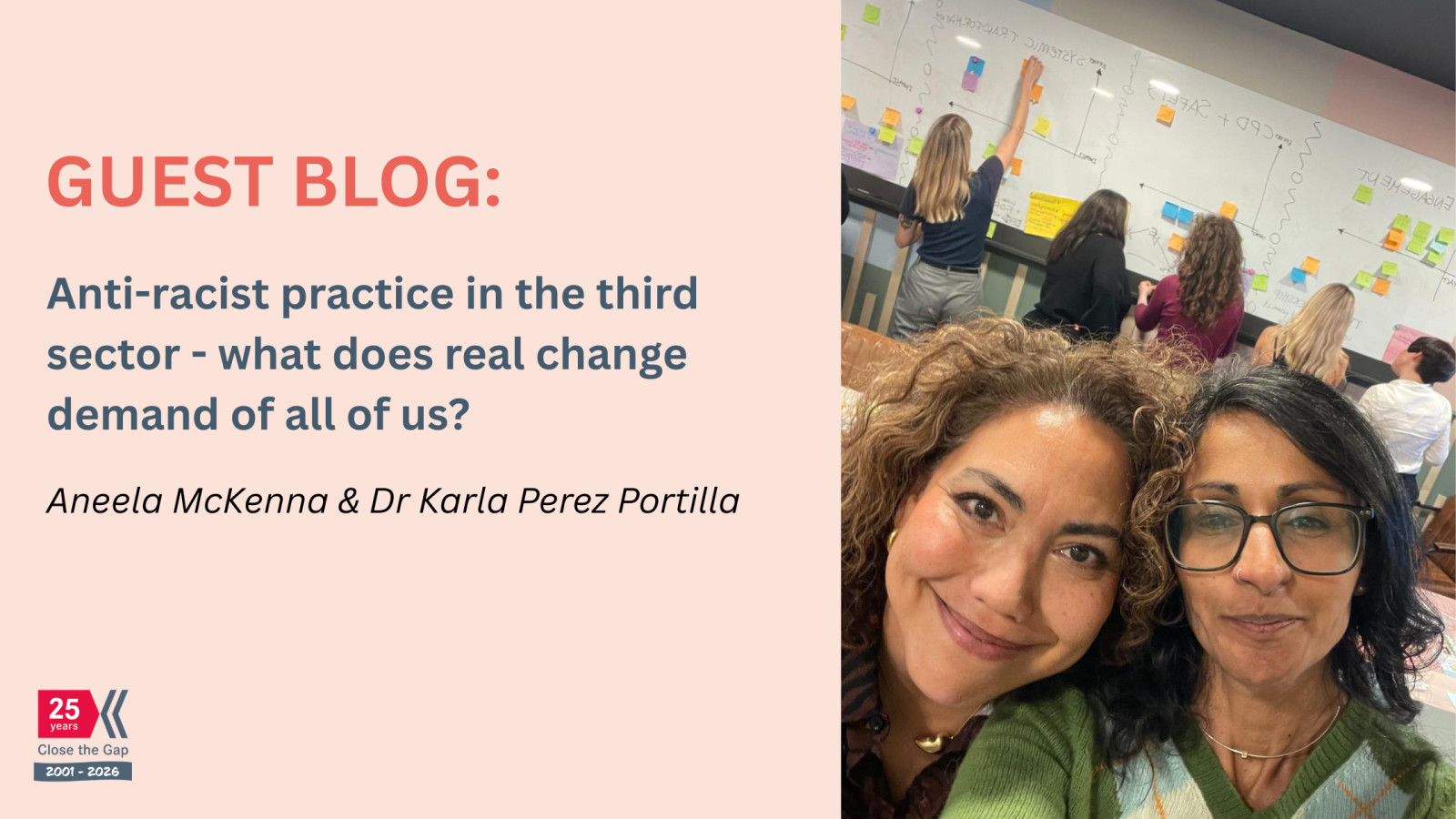
Today we’re sharing a guest blog from Aneela McKenna and Dr Karla Perez Portilla, who worked with us to develop Close the Gap’s anti-racist practice strategy. Their insights and challenge have been central to shaping this work, and to pushing us to think more deeply about what meaningful, sustained organisational change requires.
Over the past year, we worked closely with Aneela and Karla to examine our policies and practice through an anti-racist lens. This included an external audit, all-staff training, and a series of workshops that created space for reflection, discomfort, and learning. Together, this process helped us move from commitment to action, and informed the development of our strategy. In this blog, they reflect on what an intersectional and anti-racist approach demands in practice, drawing on their experience of working with us and across the wider third sector.
Karla: I met Aneela in October 2004 when we began our MSc in Equality and Discrimination at the University of Strathclyde – over twenty years ago. We connected from the first day. We were young women from adversely racialised backgrounds, both driven to make a difference.
At the time, Aneela was the first Equality, Diversity and Inclusion Officer at the University of Glasgow, while I was a Chevening Scholar from Mexico, having just published my first book On the Principle of Equality. Since then, we have taken on many roles.
I have worked across academia, the public and third sectors on anti-racist and anti-discrimination projects, focusing on making anti-discrimination law more accessible and effective. Aneela has led equality programmes in the public sector and now runs her own consultancy, Mòr Diversity. After more than twenty years, we have come together again to support Close the Gap’s anti-racist work – a collaboration that has deepened our bond and shared commitment to meaningful change.
A collaborative reflection
This blog is a collaborative reflection structured around three questions. Karla leads on the first, Aneela on the second, and we address the third together.
1.What does the third sector need to do to take a genuinely intersectional and anti-racist approach?
Karla: A good starting point is to ask some honest and fundamental questions: why do we want to take this approach, and why now? Who are our services, goods, and employment structures designed for, by whom, and for what purpose? And who actually benefits from them in practice?
The question of why is crucial because it shapes motivation. When action is driven primarily by fashion, funding requirements, or political pressure, it is rarely sustainable. Meaningful change requires genuine compassion because fairness and dignity matter, not because we are being watched. As Fannie Lou Hamer reminded us, nobody is free until all of us are free.
Asking who our services really work for brings intersectionality into sharp focus. Deconstructing privilege is not about blame or punishment; it is about examining how resources, access, and advantage are distributed and whether they can be shared more equitably. A universal approach — treating everyone the same — may appear fair, but in practice it often is not. Offering everyone a seat at the table assumes the same chair works for all, when in reality, different people need different forms of support. Intersectionality helps us design systems that deliver substantive, not merely formal, equality.
I therefore suggest a three-part approach:
- first, clearly declare an intention to be anti-racist and intersectional;
- second, commit to specific, measurable changes; and
- third, sustain action over time. Fairness and inclusion are not end points but ongoing commitments that must be actively maintained.
Aneela: Karla is right: commitment must be sustainable. The third sector often follows funding and policy, but it cannot lose its active role in building an intersectional and anti-racist approach. Too often, communities are treated as homogenous groups. We must recognise the multiple identities people hold and ensure services truly meet their needs.
Gender equality work cannot advance without an anti-racist lens. Kimberlé Crenshaw’s concept of intersectionality emerged because feminist approaches that focused only on more privileged women erased the compounded oppression faced by adversely racialised women. This is a critical moment for the third sector to challenge the racist narratives embedded in everyday life through social media, political discourse, and our daily conversations. We need collective action and a unified voice that says racism is not welcome. Commitment alone is not enough; we need sustained action, intentional representation, and a long-term focus.
2.What are examples of good practice?
Aneela: There is no perfect model, but I look for good practice within specific workstreams. One thing organisations fear most is often the best way to becoming anti-racist: delivering programmes for adversely racialised groups or setting diversity targets. People say this takes opportunities away from others. But positive action (which is lawful, unlike positive discrimination) is a vital tool – proactive outreach, leadership programmes, bringing adversely racialised people into decision-making. As Sir Geoffrey Palmer once said, “talent is everywhere, opportunity is not.” Positive action helps close the ethnicity gap.
Second, nothing happens without data. When you take a proposal to a board, they need evidence that targeted action is necessary. Data collection should be ongoing from staff, volunteers, the communities you serve as well as those you are failing to reach. Data reveals the inequalities we’d rather not see, providing the hard evidence that makes the status quo indefensible and action unavoidable.
Finally, cultivate partnerships that challenge your institutional thinking and question your practices. Be honest about the model you’re using and what the expectations are; don’t define the relationship as something it isn’t. Be transparent about where the power sits, but also actively address how that power can be redistributed to adversely racialised communities. We cannot claim a process is collaborative if the structural ownership never actually shifts.
Karla: I fully agree on the importance of positive action: it is statistically and morally justified, legally permitted, and a crucial means of fulfilling the UK’s Public Sector Equality Duty. I would like to add a personal reflection. On one occasion, I was asked to identify countries doing anti-racist work ‘better’ than the UK, implying that, in the absence of clear examples, urgent action was unnecessary. This comparison is flawed. Inequality and discrimination are historically produced and deeply contextual. No other country shares the UK’s specific imperial history or has benefited in the same ways from colonial exploitation. The UK must therefore respond seriously to its own history and present realities.
3. So, what does real change demand of all of us?
Karla: Social inequality is not natural; it is made — and what is made can be unmade. We know change is working when it becomes uncomfortable. As I often tell my students, muscles grow because they burn during exercise. Real change is no different: it unsettles and disrupts the status quo. Organisations should therefore recognise discomfort not as failure, but as a sign of progress.
Aneela: Too often, this work is left to the one adversely racialised person on the team—that is not sustainable. Don’t leave them to carry the weight alone. Allocate resources, set strategic goals, and build firm accountability so that equity becomes everyone’s responsibility. Let it come from the board and leadership, not just from those with lived experience. We can all lead with an intersectional lens. True inclusion does not rest on the shoulders of one ‘champion’; it requires a unified movement to turn commitment into lasting change.
 RSS
RSS