Blog
Close the Gap launches anti-racist practice strategy for 2026 to 2029
Today we’re publishing Close the Gap’s anti-racist practice strategy for 2026 to 2029. It’s not a document we publish because we’ve arrived somewhere, it’s a public commitment to a journey of organisational change that we know will take sustained effort, honesty, and time.
Close the Gap exists to advance women’s equality in the labour market, and we know that structural change is necessary to realise this. Systemic inequality must be named and challenged if it is to be dismantled. As Kimberlé Crenshaw’s seminal work on intersectionality makes clear, genuine gender equality cannot be achieved without an explicit anti-racist lens. Centring intersectionality means going further than we have, and this strategy sets out how we’ll do that.
Our work to get here
Over the past year, we’ve worked with Aneela McKenna of Mòr Diversity and Dr Karla Perez Portilla, whose subject matter expertise and lived experience has been crucial in this process. Part of this work involved a comprehensive anti-racism external audit of our policies and practice. The findings were uncomfortable but clarifying; Close the Gap had pockets of good practice and genuine commitment, but these were not systematised. Anti-racism principles were not fully integrated into our policies, our project design, our communications, or our culture. Passion without structure isn’t enough. Good intentions without accountability aren’t enough. The strategy is our response to that.
The process was also shaped by engagement with an external group of racially minoritised women. We’re grateful to them for trusting us and sharing their lived experience. Their involvement was not a tick-box exercise, it was an essential component of this work.
Why speaking publicly matters
Close the Gap is a small organisation of eight staff, led by white women, with a majority white workforce. That context matters because it means we need to learn, it shapes how we listen, and it’s why external expertise and lived experience have been central to this process rather than optional extras.
The current political context is also important. The rise of far-right activism in Scotland and across the UK, and increased racism and anti-migrant rhetoric in public discourse make this work not just an organisational priority but a political necessity. Silence in this climate is not a neutral act.
Publishing a strategy means being held accountable. Too often, organisations make commitments on anti-racism and gender equality that do not lead to meaningful change. Organisations that never declare publicly rarely do the work at all. We know that accountability requires visibility. And if Close the Gap is asking employers to create anti-racist, gender-competent workplaces, we have an obligation to build one ourselves.
There will be discomfort, learning, and missteps along the way. The strategy is designed with that reality in mind; it’s iterative, annually reviewed, and grounded in continuous improvement rather than presuming to have all the answers from the outset.
What we’re committing to
The strategy sets out our commitment across four interconnected workstreams:
- how we position ourselves externally and build genuine engagement with racially minoritised women and anti-racism organisations;
- how we transform our internal culture, systems, and processes;
- how we embed continuous learning across the whole organisation, both with the staff team and the board; and
- how we formalise accountability, both for ourselves and in the expectations we place on the employers we work with.
We’ve developed an evaluation plan with indicators of success, and we’ll publish annual updates sharing what we achieved and, just as importantly, what we didn’t. As a small third sector organisation in an increasingly challenging funding context, capacity is a real barrier. We recognise that learning as we go will present its own challenges, but know that there’s much to be learnt from not getting something right the first time.
Why this work is essential
The engagement with our staff team and board over the past year was both authentic and, at times, uncomfortable in exactly the right ways. The guiding principles we’ve arrived at - sitting with discomfort, sharing accountability, centring lived experience, and being open to growth - reflect the genuine commitment and enthusiasm from staff and trustees about the work that we’re doing.
This strategy also connects directly to the core of Close the Gap’s mission. Racially minoritised women face compounded inequalities in the labour market, in pay and progression, in the way their work is valued, and whether their voices are heard. If we don’t name that, if we allow our work to flatten women’s experiences into one undifferentiated category, we’re part of the problem we claim to be solving. The language of intersectionality has been increasingly adopted, but too often it’s without an understanding of what it means in practice, and without the necessary action to create change for racially minoritised women.
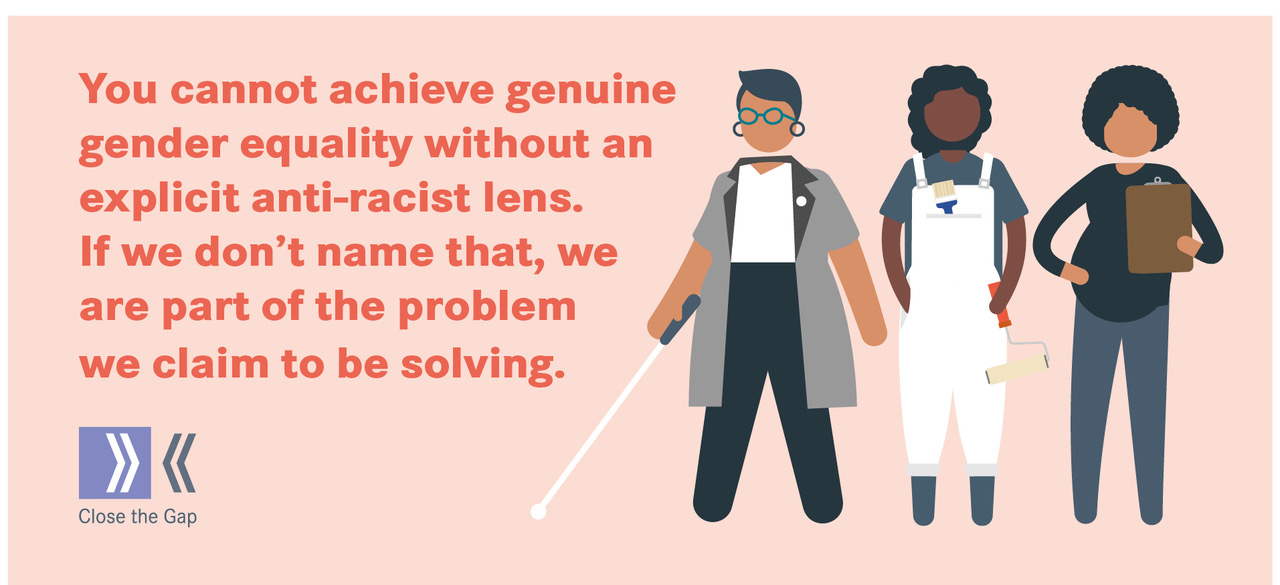
“You cannot achieve genuine gender equality without an explicit anti-racist lens. If we don’t name that, we’re part of the problem we claim to be solving.”
How we’ll be held to account
Publishing this strategy is one of the ways we will hold ourselves accountable. We have also built structured accountability mechanisms into the strategy, including setting out clear indicators of success in an evaluation plan that will be regularly reviewed, and a commitment to share annual public updates on progress. Those updates will be honest about what we’ve achieved and where we have fallen short. Our board of trustees also has a critical oversight role both in ensuring the plan is delivered, but also in how they change adapt their own governance practice to be anti-racist. We’re now on a journey to becoming an anti-racist organisation, and that is what advancing justice and equality for all women actually means.
 RSS
RSS