Blog
Challenge Poverty Week 2026: Fair Work for Disabled Women
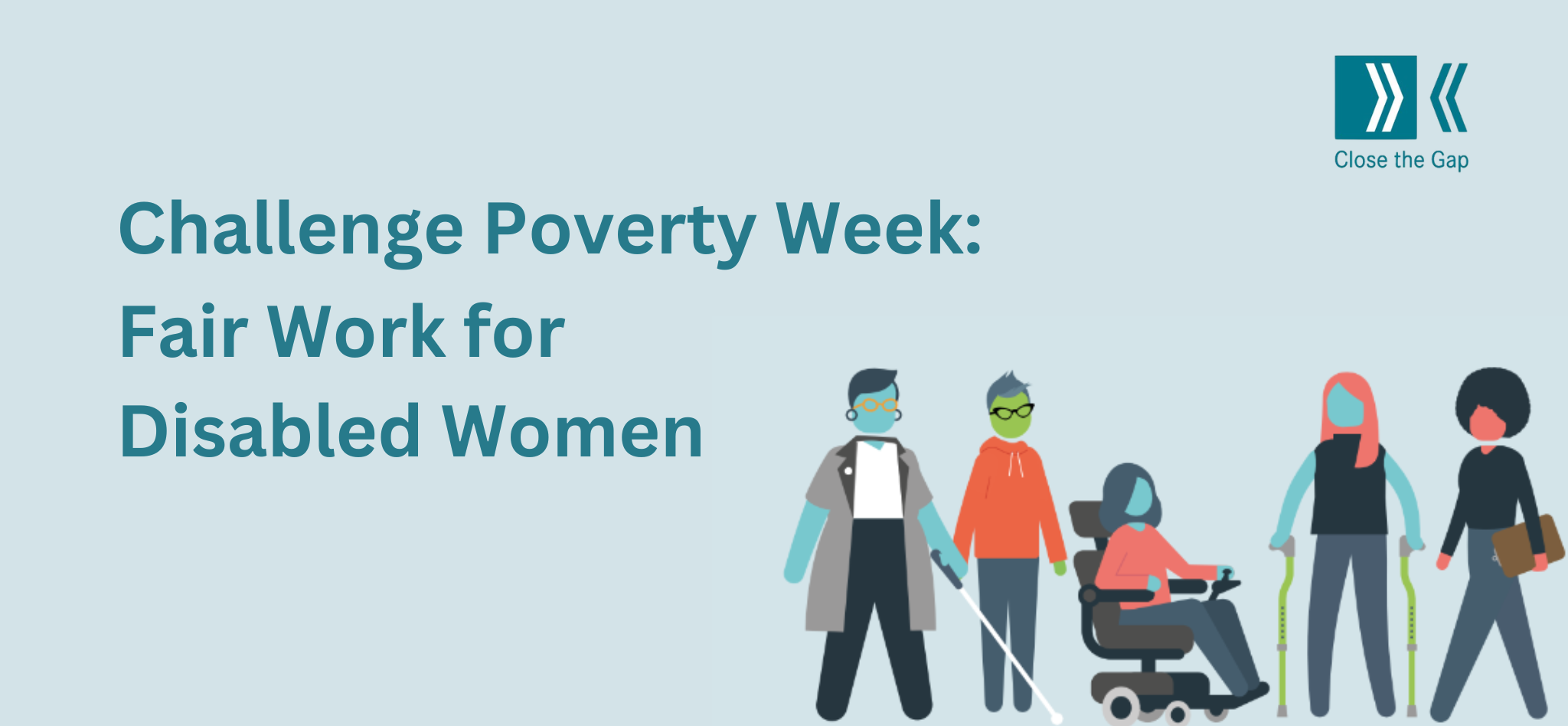
This week is Challenge Poverty Week and for today’s theme of Fair Work we’re highlighting disabled women’s experiences of the workplace and barriers to accessing fair work.
Poverty through a disability and gendered lens
Women in Scotland are more likely to experience poverty than men throughout their lives and continue to face a gender pay gap. The reasons behind women’s high risk of poverty have been explored in our previous blog about inadequate incomes. Today, we are highlighting disabled women’s disproportionately high levels of poverty and barriers to accessing fair work. In 2024, the poverty rate for disabled women in the UK was 35%, 17 percentage points higher than for non-disabled women. When the higher cost of living associated with disability is taken into consideration (calculated at £1,095 per month on average) it is estimated that poverty rates rise closer to 50%.
The pay gap data for disabled women is striking here, as disabled women’s average hourly pay is lower than non-disabled men (23.2% gap), non-disabled women (9.6% gap) and disabled men (9.2% gap). When disabled women are employed, they are more likely to be in low-paid and precarious work, which is a major cause of the higher level of poverty they experience. A key driver is acute and chronic occupational segregation, with more than 40% of disabled women working in health, social care or education, sectors that are often low paid and undervalued.
Women’s poverty is intrinsically linked to children’s poverty and families with a disabled adult or child are one of the Scottish Government’s priority family groups at greatest risk of poverty. Disabled mothers face structural barriers to employment, such a lack of support in the workplace, including flexible working and other reasonable adjustments, and inaccessible childcare, due to both disability discrimination and gendered norms around caring. Despite this, the latest Child Poverty Delivery plan has no specific actions targeted at the barriers disabled women face in accessing and progressing in employment.
Last week, Close the Gap published important new research into fair work for young mothers. Strengths not Stigma found that half of the young mothers who participated in the research had a long-term physical or mental condition and for some this affected their ability to enter and sustain paid work. The research also found barriers for young mothers in accessing suitable childcare for disabled children and those with additional support needs. This is significant, as 55% of households with a mother aged under 25 are living in poverty, the highest rate of all the priority family groups. Furthermore, 42% of young mothers experience in-work poverty.
Disabled women and “economic inactivity”
Disabled women are also more likely to be underemployed or ‘economically inactive’. In fact, data has shown that ill health has become the top reason for women being economically inactive, surpassing caring responsibilities for the first time. Many disabled women want to work but face structural barriers such as discrimination in recruitment, inaccessible workplaces, inadequate employer awareness of reasonable adjustments, and a lack of accessible childcare. These factors drive the disability employment gap and contribute to higher levels of poverty.
This health-driven rise in economic inactivity occurs against the backdrop of UK Government proposals to cut disability benefits (including Personal Independence Payment and the health element of Universal Credit) and reduce Access to Work support. In our response to the UK Government’s Pathways to Work consultation we expressed strong concerns that these cuts will force many disabled women out of employment.
Centring disabled women’s experiences of work
Last year, Close the Gap published Excluded by Design: Research on disabled women’s employment in Scotland. This research uncovered discrimination towards disabled women at every stage of employment, from recruitment to access to reasonable adjustments and development opportunities. Concerningly, almost three-quarters of the survey respondents had experienced physical or mental harm at work.
Under the Equality Act (2010), disabled people can request reasonable adjustments at work. Despite this, many disabled women face challenges obtaining them, with only 36.4% of respondents reporting adjustments were put in place immediately. Participants reported having to repeatedly advocate for reasonable adjustments due to poor employer understanding.
A ‘hierarchy of impairment’ was evident in the research, with mental health needs and neurodivergence less likely to be accommodated by employers. This is particularly concerning as recruitment processes were found to be especially challenging for neurodivergent women when compared with those with mobility-related access needs. Neurodivergent women further reported reluctance to disclose their condition due to fear of stigma.
These factors compound to create significant barriers to disabled women accessing and progressing in fair work, contributing to their risk of poverty.
What is needed to achieve fair work for disabled women
Disabled women remain invisible in policy frameworks, with no specific mention in the Programme for Government 2026-2031, despite promises to increase disabled people’s employment and review employability support services.
Issues affecting disabled women sit at the intersection of multiple policy frameworks on disability, gender, employability, the economy and fair work. These areas often operate in silos, meaning the intersecting inequalities disabled women face are not addressed. In the Scottish Government’s Fair Work action plan, for example, there are no specific actions targeted at reducing disabled women’s economic inequality.
The Scottish Government needs a robust and meaningful intersectional analysis of how gender and disability, as well as compounding factors like race and young motherhood, create distinct inequalities which push disabled women into poverty. To do this, there must be better intersectional data collection and accessibility to enable targeted action to address the barriers disabled women face. Close the Gap are calling for disabled women to be centred in future fair work policy and in the current review of employability services. Meanwhile, the UK Government must halt the planned cuts to Universal Credit which will have a devastating effect on disabled women. Urgent action is also needed to improve Access to Work, including adequate investment in the programme to address the acute delays, and ensure that the needs of disabled women are at the centre.
Employers also play a hugely important role in ensuring their policies and practice do not exacerbate inequalities for disabled women. Line managers and recruiters need to be trained on accessibility and providing reasonable adjustments and accessibility. Flexible working should be a default-yes policy so that disabled women can better manage work with their condition or impairment, and commitments like childcare. Employers should also review their performance management system to ensure that disabled women are not disproportionately penalised when they don’t have the support they need to do their job. Many disabled women want to progress in their role but current practice is preventing them, so it’s also important for employer to review how progression happens in their organisation to ensure that disabled women are not disadvantaged.
To find out what else needs to change, read our fill list of recommendations.
 RSS
RSS