Blog
New webinar series - Men’s jobs and women’s job: how work got this way and what we can do about it
Tackling occupational segregation is central to Close the Gap’s work. The tendency for men and women to do different types of jobs and work at different levels is a defining feature of Scotland’s labour market. Women’s employment is concentrated in undervalued, low-paid, and underpaid jobs such as care, cleaning, and nursing. This segregation drives women’s poverty and child poverty, it restricts women’s (and men’s) choices, and it sustains the gender pay gap. Despite being such a significant cause of women’s labour market inequality, occupational segregation seems to be an intractable problem on which there has been little to no progress. In some areas, for example, tech, progress has actually reversed.
Occupational segregation is a cradle to the labour market problem, and policymakers have failed to get to grips with the level of action that’s needed to address this from early years to stopping the leaky pipeline. Instead, policy responses have largely focused on supply-side initiatives to equip more girls with STEM skills. There has been far less attention on the structural change that needs to happen in the workplace, and in wider policy areas such as childcare. There has been even less attention on the economy-wide undervaluation of ‘women’s work’ such as social care and childcare. This economic injustice persists even though, as Covid exposed, women’s work is essential to Scotland’s economy and to our society.
In 2026, we want to bring this ‘wicked problem’ into focus. We know that occupational segregation is not well understood by policymakers, employers or other key actors in women’s employment. From our work with employers, we’ve found that many are unclear about what the causes are, and importantly, how they can make a dent in the rigid patterns they see in their organisation.
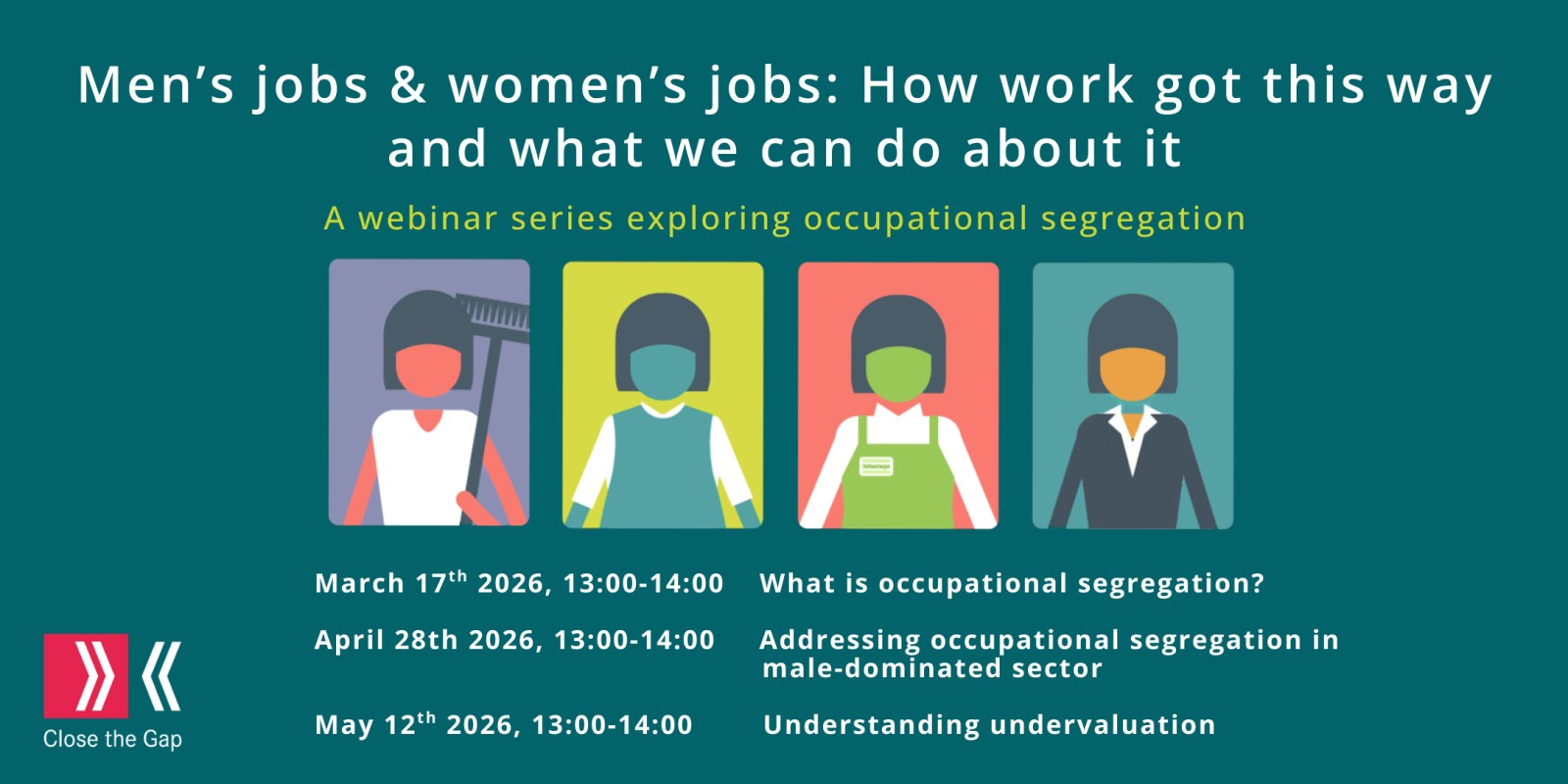
This year marks the 25th anniversary of Close the Gap. Throughout the year, we will commemorate this milestone with a series of events, blog posts and activities to reflect on our journey so far and set out our vision for the future. To kick things off, we are launching a three-part webinar series exploring occupational segregation in more detail. This series, Men’s jobs and women’s jobs: how work got this way and what we can do about it, is designed to build capacity in employers by providing practical information and good practice examples from different sectors. We have an expert programme of speakers from employers from different sectors, trade unions, and organisations working on gender equality.
Webinar Details
You can find more information on each webinar and links to register below:
1. What is occupational segregation?
Date: 17th March 13:00-14:00
This session will introduce the topic and explore the causes and why occupational segregation persists. We will have expert speakers including:
- Anna Ritchie Allan, Executive Director at Close the Gap
- Dilraj Sokhi Watson, Director of Equate Scotland, the national organisation working on women in STEM sectors
- Susie Heywood from Gender friendly Scotland, who work on challenging gender stereotypes in early years
To register for the webinar, visit https://events.teams.microsoft.com/event/d17901c4-457b-401c-a7b0-b6bac3006359@35d08309-45f5-434a-bab9-1788fe402fb6
2. Addressing occupational segregation in male-dominated sectors
Date: 28th April 13:00-14:00
In this webinar we will be hearing from organisations who have been successful in rolling out targeted approaches to increasing the number of women in their male-dominated workforce. We are pleased to be joined by:
- Sara Turkington, Equality, Diversity & Inclusion Manager at ScotRail
- Gareth Hind, Director of Colleague Experience and Internal Communications at First Bus
To register for the webinar, visit https://events.teams.microsoft.com/event/7f1002cd-365d-46f8-bb56-09c96e90a959@35d08309-45f5-434a-bab9-1788fe402fb6
3. How undervaluation drives occupational segregation
Date: 12th May 13:00-14:00
In our third session we will be exploring undervaluation. The concept of undervaluation underpins gendered pay inequality, occupational segregation and the gender pay gap. The skills needed to do ‘women’s work’ such as social care, childcare and nursing are less valued than comparative jobs done by men. This means that ‘women’s work’ is often associated with lower pay and poorer terms and conditions. This causes sector-wide issues such recruitment and retention challenges and ongoing equal pay claims. We will be hearing from:
- Lauren Mackie, Women’s Campaign Unit at GMB Scotland
- Eileen Mckenna, Associate Director of Nursing, Policy and Professional Practice at Royal College of Nursing
To register for the webinar, visit https://events.teams.microsoft.com/event/12dbda8f-da64-4388-a542-a8fa1dc53769@35d08309-45f5-434a-bab9-1788fe402fb6
The webinars will be recorded and available after the session.
 RSS
RSS