Blog
Think Business, Think Equality launch at The Lighthouse
Last Friday we launched our Think Business, Think Equality tool and accompanying short films at The Lighthouse in Glasgow. The free, online tool allows small and medium businesses to self-assess their business practice by taking one or more of five short tests based on specific themes: flexible working, workplace culture, pay and reward, progression and promotion, and the different jobs that women and men tend to do. On completion of each test you receive a report based on your answers, and a personalised action plan for your business which details simple changes you can make to your workplace practice that are good for your people and for your business as a whole. You can also access more detailed information on each topic with free downloadable guidance, allowing you to tailor your approach as much as you like.
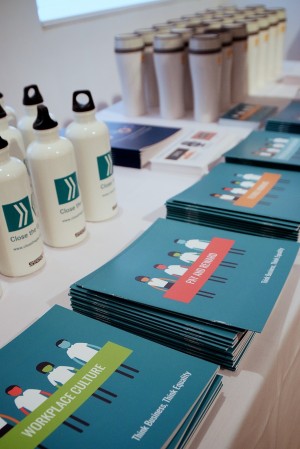
We were very proud to unveil our four short animations, produced by Media Co-op, which bring to life the business benefits of gender equality, each in a punchy 30 seconds. Each film centres on a different theme, from innovation to valuing your people, and we hope these will grab the attention of people working in small and medium businesses, and pique their interest in the tool.
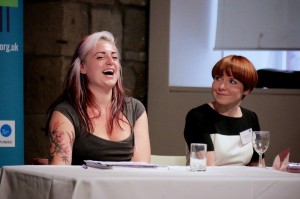
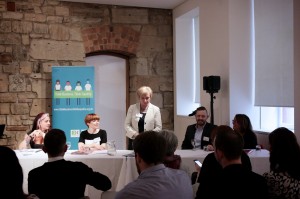
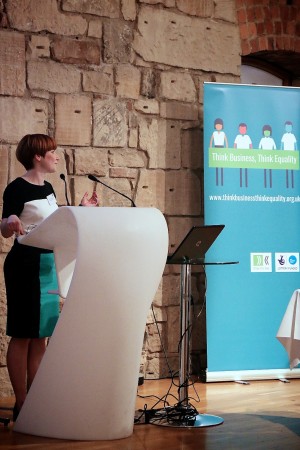
The event was chaired by Anne Meikle from Women’s Enterprise Scotland, and we heard from our own Anna Ritchie Allan on the business benefits of gender equality, and Amanda Turner gave a step by step walk through of one of the tool’s tests. We were also delighted to have Patrick Byrne, CEO of Pursuit Marketing, and Pursuit’s Operations Director Lorraine Gray, in attendance to give a business’ perspective on the tool. Event attendees included SME owners, business agency representatives and equalities specialists; it was a great chance to hear different perspectives, and there was a very productive networking session afterwards.


The tool is available online at www.thinkbusinessthinkequality.org.uk, and you can also download the free app for iOS, Android or Windows.
EVENTS: SCOTLAND AND UK WIDE
In this post you will find a selection of up and coming events and programmes relating to gender equality and women's participation in the labour market.
___________________________________________________________________________________
Engender
Gender Matters: Equality and Inclusion Through Care Conference
Tuesday 13th October 10am - 4pm
The Lighthouse, Glasgow
FREE
Over the past two years, Engender has been working with Professor Kirstein Rummery to examine how care policy could be used to achieve gender equality, and what Scotland could learn from care policies around the world.
This conference will examine issues such as childcare and long-term care, and how these impact on gender equality, with input from expert speakers.
____________________________________________________________________
Commission on local tax reform
Help shape the future of local tax - Workshop with Women's Groups
September 7, 2015, 13.00 – 16.00
Glasgow Caledonian University
The Commission on local tax reform wants to hear from women about what they think might be a fairer way to raise the £2 billion presently collected from council tax in Scotland.
The event will last around 2.5 hours and will involve you taking part in an interactive discussion. Members the Commission will also attend to hear your views first hand. Refreshments will be provided.
__________________________________________________________________
EQUATE SCOTLAND
Take Action To Recruit Female Apprentices
11 September 2015- 09.30
FREE
Venue: Carnegie Conference Centre, Halbeath Rd, Dunfermline, Fife, KY11 8DY
Equate Scotland and Fife College are holding a free half-day seminar to support employers and training providers to recruit and retain female talent in engineering and construction, through apprenticeship pathways.
The session aims to confirm the importance of positive action and looks at strategies to encourage a wider pool of young people, in particular girls and women, to consider engineering apprenticeships. The session is aimed at engineering employers, training providers and those responsible for recruiting, training and managing apprentices.
Find out more about this event or Book for this event
Career Enhancement Programme
30 September 2015 - 10:00
FREE
Edinburgh
Host - Equate Scotland
A free three day course designed for progressing women working in engineering and advanced manufacturing, taking place over three days between September and December this Autumn.
Find out more about the programme, or book for this event
________________________________________________________________
WISE - Women in Science and Engineering
A wide range of events across the UK from small workshops through training courses to major conferences. See more information
Think Business, Think Equality launch event
Close the Gap is launching its Think Business, Think Equality online self-assessment tool which is designed specifically for small and medium businesses and organisations.
The free online tool enables employers to self-assess their employment practice, and provides tailored advice and guidance on the ways in which their business can benefit from gender diversity.
Delivering workplace equality makes good business sense. Having fair and flexible working practices allows you to attract and retain the best talent, reduce recruitment and training costs, and it makes your business more productive, more innovative, and more profitable.
The new online tool will be launched in Glasgow along with our new Think Business, Think Equality promotional films. You will also be able to hear from a business owner who has used the Think Business, Think Equality tool.
The launch event will take place on 28th August 2015 from 4.00pm - 5.30pm at The Lighthouse, Mitchell Lane, Glasgow, G1 3NU. Wine and canapes will be available.
If you would like to attend, register here.
If you would like more information on the event or the toolkit, please get in touch at info@closethegap.org.uk
JULY NEWSROUND
Close the Gap’s Newsround is back after a short break. Here we round up all the news about women in the labour market, and all things related. This month’s stories cover welfare reform, publishing gender pay gaps, rising maternity discrimination and more.
The Sunday Times
Change work culture to close the pay gap - Anna Ritchie Allan
The Guardian
Women aren't dropping out of the labour market just because they're pregnant
Sometimes I have to leave work early to pick up my kids. Deal with it.
David Cameron to force companies to disclose their gender pay gap
Maternity discrimination means 54,000 women lose their jobs every year.
Sainsburys faces equal pay battle with female shopfloor workers
It's not just sports, all women's initiatives lack corporate sponsorship
BBC
Female solicitors paid less than men
Women 'hit hardest by benefit cuts'
The National
Budget reaction: Continuing the programme which impoverishes women - Emma Ritch, Engender
Iain Duncan Smith's welfare department has only two women
CIPD
Why gender pay gap reporting divides employers
The Scotsman
China: Fines for pregnancy without permission
Creative Scotland meets Sturgeon's gender target
International
Gender gap in federal salaries? Let's not go there anymore, says new personnel chief
EVENTS: SCOTLAND AND UK WIDE
In this post you will find a selection of up and coming events and programmes relating to gender equality and women's participation in the labour market.
___________________________________________________________________________________
Close the Gap
Think Business Think Equality launch
Friday 28th August 4pm to 6pm
Venue to be confirmed (Glasgow City Centre)
Close the Gap is launching its Think Business, Think Equality online self-assessment tool which is designed specifically for small and medium businesses and organisations.
The free online tool enables employers to self-assess their employment practice, and provides tailored advice and guidance the ways in which their business can benefit from gender diversity.
Delivering workplace equality makes good business sense. Having fair and flexible working practices allows you to attract and retain the best talent, reduce recruitment and training costs, and it makes your business more productive, more innovative, and more profitable.
The new online tool will be launched in Glasgow along with our new Think Business, Think Equality promotional films. You will also be able to hear from a business owner who has used the Think Business, Think Equality tool.
Refreshments will be available.
Book for this event____________________________________________________________________
Commission on local tax reform
Help shape the future of local tax - Workshop with Women's Groups
September 7, 2015, 13.00 – 16.00
Glasgow Caledonian University
The Commission on local tax reform wants to hear from women about what they think might be a fairer way to raise the £2 billion presently collected from council tax in Scotland.
The event will last around 2.5 hours and will involve you taking part in an interactive discussion. Members the Commission will also attend to hear your views first hand. Refreshments will be provided.
__________________________________________________________________
EQUATE SCOTLAND
Sticky Floors and Glass Ceilings
26 August 2015 - 10:00
FREE
Venue - The Vine, Dundee
Host - Equate Scotland
One day career development course looking at the 'sticky floors' and 'glass ceilings' which can prevent women making the most of their skills, knowledge and abilities. See more:
Who can attend?
Women qualified or working in engineering and advanced manufacturing.
Career Enhancement Programme
30 September 2015 - 10:00
FREE
Edinburgh
Host - Equate Scotland
A free three day course designed for progressing women working in engineering and advanced manufacturing, taking place over three days between September and December this Autumn.
Find out more about the programme, or book for this event
________________________________________________________________
WISE - Women in Science and Engineering
A wide range of events across the UK from small workshops through training courses to major conferences. See more information
 RSS
RSS